Sunday, 15 December 2013

How I became Poppo Mike

This post was written by my guest writer, variously known as the 'war office' - 'she who must be obeyed' - 'her indoors' - but most importantly the LOVE of my LIFE. Here we go:


Why My Mike’s Blog is called Poppo Mike.

1990, Mike suggests a Sunday drive to York. York being a lovely country town, there wasn’t that much open.
I said to him, I have friends that don’t live too far from here in Popanyinning (only just over 100 km’s away), Gill and Ted, who’d been friends since my young teenage years.

Eureka - I found IT !!

So to Poppo we go, at that time Gill and Ted were living on the main street, They also had 45 acres, or as Ted always called it “His estate”. Just over the railway line. They had recently put a house on and wanted to know if we would like to see it. They were in the process of doing it up ready to live in. Mike quick as a whip said “yep”. Back then I was such a city person, always wearing high heels and tight skirts. I went along. We saw the house, then Ted said would you like to walk the block. Mike full of enthusiasm, me “NO” there might be some snakes out there. This was one of Teds favourite stories until he passed away.
Anyway, in the car on the way home, Mike says to me, “I could live there” Me, “I couldn’t”. What would it take for you to live there, asks Mike. Me being funny “A Bath”

We went back in 1994, after we were married, and took Grandchild Venus with us. She just loved running around. Ted told Mike there is a 5 acre block for sale, so went to see it. Venus loved it, however all the time yelling “But NO geese nanny”. That block was not to be.

19995, Mike has sold the yacht Delinquent, he is more than determined now, as he put it: “you either
Will it measure up to specs? Hope so!
live by the sea or in the country”
Another visit to Gill and Ted. We stayed at the Pingelly road house & motel in room 12. Had dinner that Saturday night with Gill and Ted and talked about properties we had seen. None appealed to me. We agreed to see each other the next morning, at their house on ‘the estate’.
Ted was very excited, “I’ve seen a block” 2 and half acres, quiet street, you want to come and have a look?. Of course says Mike. Had to climb fences since there was no gate then. It was just covered in clover and looked beautiful. Mike loved it, and Yes so did I. Ted had all the details of the seller.
Driving back to the city, big discussions, Yes or No. By the time we got home it was a YES.

Phoned to tell Gill and Ted we are buying the block, done deal! Ted was very happy, however, and I still remember this, Gill says to Ted: “What have you done?” “What?” he replied. Gill: “What about Kay!“ Ted’s laconic reply was: “she’ll get used to it.”

Next task was to find a house.

To be continued.

Monday, 21 January 2013

Beating the Stasi

This is a tale of conceit, diversion and sheer cunning - all played out in the good old days of the Cold War, with all it's trepidations and 'excitement'.
Your friendly next door Gestapo Man

Stasi Emblem - says it all - doesn't it?!
The Stasi was (is) a relatively well known internal/external spy organisation of the German Democratic Republic (East Germany) - very democratic if you have to spy on your own citizens to keep them subdued and in line. For those of you wanting to know more about this outfit, you can find a fairly comprehensive synopsis by following this link: Stasi on Wikipedia
The Stasi succeeded in perfecting some of the imperfections of the Gestapo and, in my considered opinion, was aided, abetted and egged on by surviving former Gestapo members who saw and grabbed an opportunity to continue their career in this field. Surveillance, record keeping, intimidation and coercion were all part of the repertoire.
The Stasi was penetrative, omnipresent and feared by all throughout the existence of the East German regime - who's stated aim was to create a "Workers Paradise" - as long as your definition of paradise concurred with theirs and you kept your mouth shut, you were fairly right.
Here are a few short stories about how things worked and how one could avoid the scrutiny/harassment of the Stasi!

The first one is about the my Cousin Christel's husband Werner. He was a detective in the CID (Criminal Investigation Division) of the East Berlin Police Force. Werner was  the one who alerted Mum about the impending closing in of the Stasi because of Mum's assistance with Gisela's girlfriend's defection to the West - for details see my earlier blog: Becoming a Refugee
Werner was a lovable bloke with a heart of gold. He was also very 'street-smart' in that he had worked out how to keep away from the Stasi. Having returned from the war he joined the police force. A rather smart move in terms of job security and career prospects.
Werner worked out fairly early on in the piece that things were taking a turn for the worse and that old style Nazi time surveillance was back on the agenda. He worked his butt off to make it into the CID and did his very best to be an outstanding detective. His reasoning was that being in a small elite force he would be able to avoid party membership, close scrutiny from the Stasi and other harassment. He was right! As long as he excelled at his job the powers that be left him alone - they needed good detectives to clear up crimes pronto! See, even in the 'Workers Paradise' crims kept plying their trade - rape, pillage and murder occurred as they always had. Maybe not to the same extend, because penalties were rather swift and harsh - long jail sentences with hard labour or death penalties executed swiftly, were the order of the day.
By being part of that small, elite division of East Berlin's police force Werner had not only access to all sorts of records, he was also sheltered from any pressure to join the party or become an informer.

'Paul's' TV Tower
The second story is about my brother in law Paul, another 'street-smart' gentleman who worked out that one had to be outside the system, so to speak, to avoid scrutiny, yet be part enough of the system to reap some benefits.
Paul, having fled the former German province of Silesia with his parents in the dying days of the war, took up a bricklayer's apprenticeship, which he completed in eighteen months. He then proceeded to buy a vacant, disputed block of land and build his own house on it. Materials were hard to come by, but he found ingenious ways of getting what he needed bit by bit - mainly trading his skills for goods.
Paul joined the East Berlin building monopoly (a state owned amalgamation of building companies) and enrolled in evening courses to become an engineer. He ended up working his way up to chief surveying engineer in East Berlin. One of his greatest achievements was to be the surveying engineer for the construction of the Television Power at Alexander Platz - a showpiece of East German prowess and determination.
Having 'manoeuvered' himself into this position he was fairly immune to the shenanigans of the Stasi - the powers that be needed his talents and cunningness - he'd become an 'untouchable'. Paul could get things done, even when materials were seemingly in short supply, and could recruit/select the right workers to ensure construction was up to standard and completed in the time allocated - a rather remarkable achievement in them days when nothing ever seemed to happen on time.
Both the Commies and the Stasi knew when they had something good in their hands and did everything to protect that asset without going overboard. Paul was, by and large, left alone politically, but he still had to wait the regulation ten (10) years to get his cherished Wartburg car - there was no way around - almost. He could get a new bath tub or toilet bowl when none were available, but a car - no way Jose!
Is there anything more adorable?
So, Paul being Paul, he waited patiently till he received his notification that his car might be forthcoming in the next twelve months. His elation was only tempered by his realisation that he could do little about the process. Thus, he thought he better do something about it - because twelve months is an eternity when you have been waiting ten years AND the notification also stated that the colour of the car was at that stage unknown, but most likely dark red or brown! Paul took some time off work, actually he pretended he had some official engagements somewhere else in Berlin, and waltzed into the office of car distribution to have a 'quiet word' to the ladies administering car distribution. Being a perennial charmer he soon had the ladies in the palm of his hand and found out that on the next delivery, due in seven days, there was a white Wartburg that the allocated owner didn't want to have a bar off or couldn't pay for. Quick as a flash Paul said: "I'll take it! How much do I have to put down to secure it?"
See, in them days in East Germany there was no such thing as Credit, Finance or Term Payments - Leasing wasn't even in the vocabulary. You paid for the goods as you picked them up or earlier. The ladies told him it was all or nothing, he would have to pay the entire amount of East German Marks 21,000.00 virtually then and there. Well, our Paul being not only handsome but also resourceful, told the ladies to hold the car for him, he'd be back in a jiffy. He hotfooted it to the bank, got a bank cheque for the amount required and was back within the hour - THE CAR WAS HIS!
How could he afford it? Between my sister Gisela and him they were pulling in the phenomenal salary of East German Marks 2,500 per month! Having saved for ten years, and not having much else to spend their money on (basic staples were dirt cheap and little else was available) they had saved that amount easily.

But, on with the story. Gisela, my sister, tormentor and whatever else - see Instant Teacher - travelled a road not dissimilar from Paul's. She discovered early on that keeping out of the clutches of the Stasi would be the best thing to do. After doing general teaching duties in primary schools Gisela discovered that political pressures kept increasing every year. 'Sniffing' around a bit she found that there was a school for children with learning difficulties in Koenigs Wusterhausen. Researching through the back door so to speak, these days we call it networking and leaning on colleagues, she go the gist as to what was required to become a teacher there - not much at all, in fact, as they were desperately short of staff and most people found it daunting, to say the least, to put up with these kids. Unruly, undisciplined, slow learners, difficult home environments - you name, it was all there. Gisela figured that this was an institution that the state had to tolerate, whether they liked or not. Anybody working there was blessed with relative freedom, mainly in the form of none-interference from the 'thought police'. She applied and, of course, got the job straight away.
This set her on her course, not only to good pay, but impunity as well.
Years later she found that, with a bit more further education, she could work her way into a more 'elite' school that was even safer in terms of the Stasi wanting informers and what have you.
Gisela applied for a study place, part time, at the famous Humboldt University to study applied child psychology. Took her four years of hard slog, but she got there - got her degree and therewith her ticket to apply for a position at the school for the blind in Koenigs Wusterhausen.
The Heritage listed School for the Blind
This school was quite unique in the GDR - one of only two such institutions for the entire country, but the only one offering university entry level tutoring and examinations. It was part boarding school and part day school. It attracted visiting educators from countries such as Sweden, Finland, Georgia, Turkey, plus numerous African and South American countries. International relations were much sought after by the GDR powers - if they had to get them through these rather burdensome institutions, so be it. With it came the relative freedom that Gisela craved. The Stasi left her alone and the government provided funding they would otherwise have denied - a showpiece is a showpiece. One has to spend money to keep it up to scratch to attract these international visitors.
Gisela advanced to the top post in the school: School Director for this unique establishment. She achieved that without having to join the party or being coerced into the role of informant for the Stasi - quite remarkable, really.
Remarkable people all three of them - but for me, I want to pay special tribute to my sister, teacher, tormentor - most of all my BIG sister - much admired, loved and sorely missed.

Sunday, 30 December 2012

Christmas - Then and Now

Xmas anno 1950 in East Germany - very frugal
Xmas Landscape near Berlin 1950's
Well, Christmas time is also a time for reflection. One thinks about what we had then and how we 'survive' Christmas now. Sometimes, it can be a bit frightening. We have come a long way with our affluence and don't, generally speaking, even notice it.
In the 'Good Old Days' (remember folks - these bad days now will soon be the good old days) one was lucky to get more than one Christmas present. If one got three or four, that was Christmas on top of Christmas.
White Xmas - it snowed a lot in the early 50's
The traditional German Christmas (as I know and remember it) comprises two parts: Christmas Eve is the big event (for children anyway), because that is the evening Father Christmas (the Weihnachtsman) arrives and brings presents for all the children.
Christmas Day is for the family feast, where everybody gathers around the 'ancestral' dining table and stuffs themselves to bursting point.
Traditionally, in Berlin, Christmas Eve fare is Bockwurst (German sausages) and Kartoffelsalat (potato salad) and mustard. This is 'gulped' down as fast as one can manage around 6 PM, because Father Christmas is waiting around the corner to dispense the presents as soon as the feed frenzy is over.
Bestest Xmas Present ever!
Honestly - who wants to eat when there are presents to be had? BUT - one had to eat to get the present/s.
Due to the very modest circumstances we lived under, Christmas presents generally were confined to two items: one toy and one practical item like a new shirt or pyjamas or thick socks, depending on what was available at the time.
My Bestest ever Christmas present came courtesy of Mum's twin sister, Auntie Maria, who managed to send this metal toy car. It was a wind-up job (clockwork motor), had opening doors, a steering wheel that actually worked and a gear lever featuring two forward gears, neutral and reverse.
Christmas day the traditional fare is goose or duck. In the early 50's geese and ducks were almost impossible to obtain, unless one knew someone who new somebody that had a small farm. The simple reason was that the meat ration stamps would never be enough to amount to even a small duck! Besides, the centrally planned food production system never raised enough birds to go around anyway. Only people high up in the political apparatus would be able to share the few birds officially produced every year.
Us 'peasants' had to make do with pork chops, sausages or liver if one was lucky. Mum, however, somehow managed every year to put on a pretend roast - some chops heavily doused in gravy and plenty of boiled potatoes.
After the Christmas day meal, which is taken at 1 PM sharp, one goes for a stroll through the winter landscape to work off the calories. Then at 3:30 PM, precisely, it is time for afternoon coffee, Christmas cake (Stollen) and a good swig of Brandy (if one is old enough). That is followed by an afternoon nap in order to build up ones strength to tackle Abendbrot (evening bread) - gluggy rye bread topped with cold cuts and cheese. Little boys, of course, don't require an afternoon nap - they play with their Christmas present, or meet friends to hear what everybody else got for Christmas.

Nowadays Christmas is quite different. For starters, living in Australia, Christmas time is usually the start of the hot summer. It was no different this year! Luckily it was not too hot this year, we had about 34 degrees Celsius on Christmas eve.
Australians celebrate Christmas on Christmas day. In the morning everybody gets their presents (note the plural) and bridges the time till Christmas lunch by admiring/showing/playing with their presents. Christmas lunch is, traditionally, turkey and ham OR, Aussie style, a variety of seafoods and salads - all washed down with copious amounts of beer or wine, or whatever your poison might be.
So in 1990, we (the wife and I) introduced and joined together our two very different Christmas's and it's worked ever since. And guess what, the kids love it! This way they get two lots of presents in succession. We are also very 'fortunate' that we have three grand kids having their birthdays on December 22 - partying and gift giving never ends at this time of the year.
The 'stunned mullett' that cooked the roast pork
This year we had the big birthday party on the 22nd for one very excited three year old and two, typically teenage kids, not so excited sixteen year olds. Things went fine, mostly, and everybody had a great time.
Pork Crackling - everybody hankers for it
Come December 24 there was a lot of running around getting last minute things. We were all geared up for our 'traditional' Christmas eve routine: roast pork (with crackling crackling), red cabbage, boiled potatoes and plenty of gravy - followed by rice pudding with chopped almonds in it and  one (or two) whole blanched almonds in it. The trick is, whoever gets the whole almond gets the 'Christmas pig' - which here is either a marzipan bar or a Toblerone (in our family - some family members don't like marzipan).
Well, everybody being sated we 'knuckled' down to the presents - kids couldn't wait! Presents - there were so many the kids eventually got 'presented' out and could take no more.
Next morning they got up and promptly asked: "Can we open presents now?!" We had to tell them that they must wait for their parents to wake before there would be any more presents.
Christmas Day Feast
Once that duty was done we returned to Poppo to prepare for Christmas dinner. Fortunately, that part of our family residing in Queensland was here this year and 'descended' upon us on Christmas day for a family feast. We had  turkey breast, oven roast vegetables and baked potatoes. Went down like a treat, everybody was happy - I think. After dinner we were all sated (filled to the hills) and just slowed down to let the food settle and recuperate.
By and large, another successful Christmas staged, consumed and done with. As always, the best part of Christmas is having little children around for the festivities - to see their eyes light up with joy when they see the Christmas tree and, most importantly, the presents under it. There is nothing better in this world than see their joy and delight every year - no matter how hot it is!
And that's it for this year! Wishing you all a very happy, healthy and prosperous 2013


Sunday, 23 December 2012

Merry Xmas - Froehliche Weihnachten

To all my loyal followers a very big Thank You for reading my posts. There will be no lengthy post this week due to the Christmas festivities and associated hectic preparing for it.

BUT - I do wish all of you a very Merry Christmas - Froehliche Weihnachten and hope you'll be inundated with presents, family cheer and good will.

I have asked some of my much adored friends to help me spread the Christmas spirit.


Have a really good one. Until next week, when there will be a Christmas post - WOOF WOOF

Sunday, 16 December 2012

Foreign Aid Part II - Perils of the Berlin Wall

Sorry for leaving you hanging, but here we go. This is about the about the perilous train journey from Copenhagen to West Berlin.
Lise did it - the candour of youth and fearlessness! We, mum and I, after mum had surreptitiously warmed to the idea of this girl coming to visit, had arranged for Gisela to meet with Lise at Ostbahnhof.
As described in the last epistle, transit passengers had to disembark the long distance train and board the small feeder on the other side of the platform.
The very curious fact, to say the least, was that East Berliners and East Germans were allowed onto that platform since the train from Warnemuende  had several carriages appended to it specifically for East German travellers from the Rostock area going to Berlin.
We had sent pictures of Lise in the months before and there was no problem the two of them finding each other. Mum maintained it was purely to ensure the girl would get safely onto the feeder to West Berlin.

It was a rather brief meeting, the salient point being that contact had been established and they would recognise each other in the future.
I picked up Lise at Zoo (that's what Berliners called the Station - being rather lazy they would never ever say: "Berlin Zoologischer Garten") and took her home on the underground to meet mum.
Being very much in puppy love and all that I didn't notice anything but the girl. Upon meeting Lisa, mum's attitude was perhaps somewhat cold, but it went right over my head.
All mum had in mind, as I found out later, was to use Lise as a mule to ferry 'contraband' to Gisela.
The poor girl was hardly at our place for a few days when mum dispatched her, laden down with two very large carry bags, to East Berlin to deliver the first load of toilet paper and washing powder.
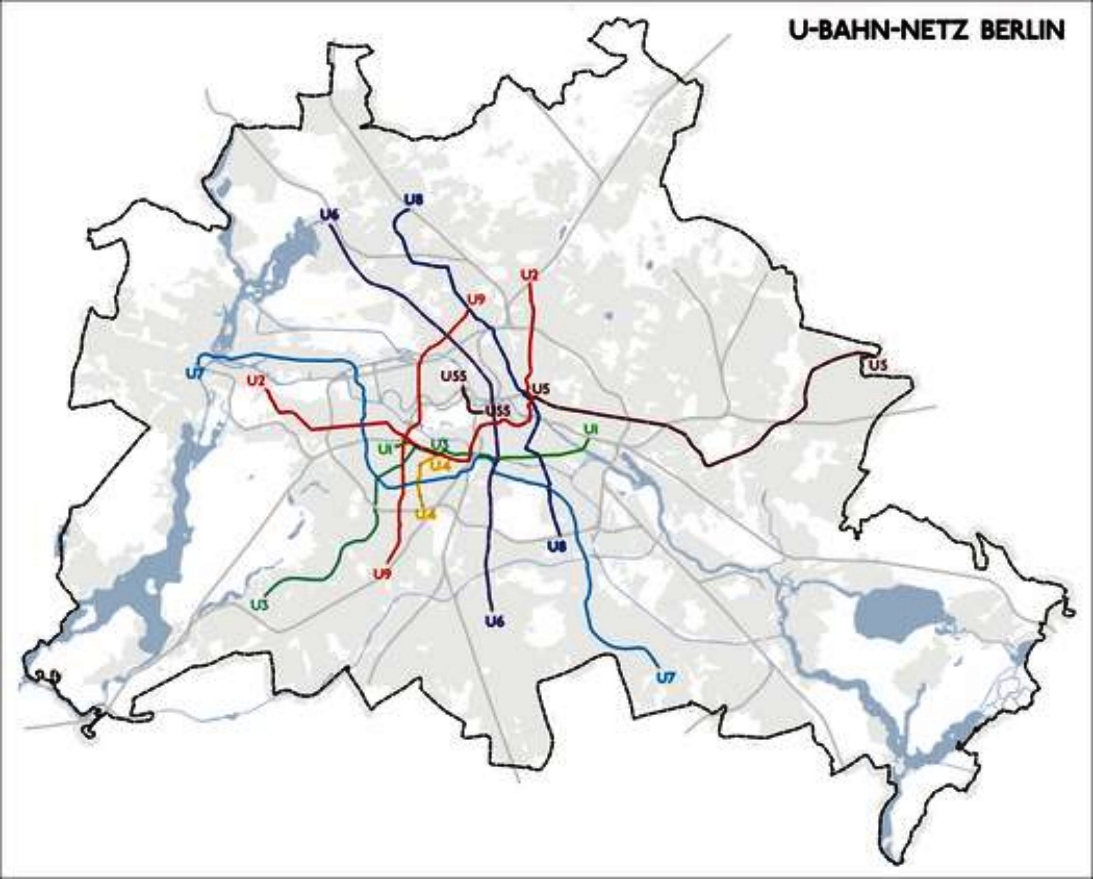
East Berlin U-Bahn network post 1961

Today's U-Bahn network in Berlin
A slight digress at this point. Once the wall went up, underground train services (what is called the U-Bahn in Berlin) were first disrupted and then re-arranged. All lines running in East Berlin were separated from the ones running in West Berlin. Small problem, though! The U 5, the north - south line, run right through the middle of East Berlin. Also, the underground station called 'Berlin Mitte', which was and is an interchange point between two underground lines, were located in the smack centre of East Berlin.
Not really a problem for the crafty Stasi - they simply shut off all underground stations on the U5 that were located in the East, they became 'Ghost Stations', and trains would rattle through them at full speed.
The only exception being Friedrichstrasse. The train would stop there and allow passengers to disembark to enter East Berlin IF they had the right credentials, i.e. be West Germans or foreign nationals!
Berlin Mitte was the same thing, it was only open in certain parts allowing West Berliners to switch from the north-south line to the east-west line.
The deliveries kept being dispatched, seeing that Lise was on holidays and so was Gisela. Both her first husband and her were teachers, so they had time off over Christmas. Gisela and her husband tried very hard to compensate the poor innocent girl for her troubles. Gisela's then husband would meet her in the late afternoon, at the Friedrichstrasse border crossing, carry her bags and take her to the opera, a concert or a play. East Germany, in those days, was very big on cultural activities and spent millions on putting up plays, operas and operettas. Admission was very inexpensive and the performances were exceptional. West Germans would travel to West Berlin to catch shows in East Berlin.
I am not sure that a 16 year old girl really appreciated being taken to a performance of  Berthold Brecht's 'The Three Penny Opera', but she seemed to 'suffer' it with dignity.

The bottom line of it all was that Gisela got her fancy washing powder, toilet paper and lovely scented soaps, Lise had quite some adventures crossing the border (like being strip searched on one occasion - I think the border guards just fancied getting a rather lovely girl down to nothing) and being asked repetitive questions, they had records and knew how many times she had crossed the 'border', about her intentions and motives.

The brave girl soldiered on and delivered all the necessary supplies for the next six months! After all, she was going to come back for the summer holidays and would stay longer than just a couple of weeks.
That way, Gisela's supplies of 'bum caressing' toilet paper and fragrant washing powder were assured for the time being.

Sunday, 9 December 2012

Foreign Aid - Perils of the Berlin Wall

This is a continuation of my previous blog 'A Taste of Danish - Part III'. As the wall was gradually being built there were, for a few weeks, quite a number of  secret paths that could be used to get to East-Berlin to meet with my Tormentor - my beloved sister Gisela. By the end of August this crossing line dried up and we were, as it is, incommunicado. Yes, one could send letters - but they would take weeks to arrive on the other side and were heavily censored. One had to be really careful what to write about - it would either be blacked out or the letter would be destroyed altogether. I think it's called censorship.
The seemingly biggest problem Gisela had then was how to wipe her bottom and wash her cloths! At the ripe old age of thirty five one would have thought she'd worked out how to wipe her bottom and launder her cloths!!
But NO - she had gotten soft! Only fourteen years earlier she was quite accustomed to wipe her bottom with torn up, crumpled newspaper and use whatever soap was on hand to wash her cloths in a bucket of cold water.
A Russian Mini-Tank in disguise
Luxuries make you soft and less resilient! Gisela by now had acquired a motor vehicle - I don't know whether I would call it a car - it was really more of a small tank disguised as a passenger vehicle than anything else. Never mind, she loved it and it made her SOFT.
Funny how little things can impede your enjoyment of daily life. Gisela was hankering for decent toilet paper and good washing powder. The stuff produced in East Germany just didn't cut the mustard for her - it didn't get whites white and didn't make the colours sparkle. Besides, the 'capitalist bourgoise' laundry powder from the West had additives that left the clothes smelling, well tantalisingly perfumed.

East German Laundry Powder - very attractive packaging!
West German Laundry Powder Effort
Here you have it! East vs West in both the packaging and advertising stakes. No wonder the East had to join the West to get some  zing into peoples life.

Meanwhile, my correspondence with Lise got somewhat frantic, her parents had reneged on their promise to let her come to Berlin for Christmas. They positively freaked out from what they saw in their newspapers. Tanks on both sides of the wall, American and Russian propaganda in overdrive and newspapers embellishing it to the hilt to sell more papers. If one believed the hype spruiked in the papers World War III was only a few weeks away. There was no way they would let their little girl venture into a war zone.
By the end of September things had settled down into a normal daily routine of nothingness. The wall was a fact, the tanks had returned to barracks and everybody got on with life as usual. In early October a letter arrived from Lise stating she would be coming, arriving the week before Christmas.  Suddenly, mum was somewhat delighted that the girl would be coming. I didn't click till much later because mum had been very apprehensive about the visit when I first told her upon my return from Denmark.

Gedser Rail-Ferry Terminal
It was quite a journey in 1961, the East Germans made it quite inconvenient for people to travel from Copenhagen to West Berlin. First, one had to catch a train from Copenhagen to Gedser, a ferry point at the southern tip of Langeland (a small island south of Zealand where Copenhagen is located). In the good old days, before the Wall, the train would be shunted onto the ferry, off at the other end and continue to Berlin. But now one boarded the ferry for the three hour sail to Warnemuende near Rostock. And here the real fun started.
Transit passengers disembarked and were greeted by a delightful immigration set-up, similar to the one on the left (the actual picture is of the last railway station in East Berlin - Bahnhof Friedrichstrasse) but they were essentially all the same, prefab and built to just one pattern.
Ironically, there were five or six lanes for incoming travellers (people actually wishing to visit East Germany) and three lanes for transit passengers. Who in their right mind would want to enter East Germany? Naturally, the Stasi officers in the visitors lanes were run off their feet - with boredom. Transit folks were 'invited' to queue in the open at their 'leisure' to wait their turn to go through passport control getting a transit visa and then customs, that would rifle through their luggage.

Knut - the cute! I am soooo shy
Berlin Zoologischer Garten
Nobody could work out why since passengers were 'guided' to the train, which was securely locked once everybody was on board. The train would then proceed at a rapid snails pace towards Berlin, where it terminated at Ostbahnhof, located almost in the middle of East Berlin. There passengers would disembark, cross the platform into a small feeder train (just two carriages) that would eventually bring them to the then main railway station in West Berlin - Berlin Zoologischer Garten. And guess what? The Berlin Zoo of Knut fame is right next to the railway station - what a coincidence.
However, nothing was easy in those days! What should have been a short fifteen minutes trip took over an hour, because the little feeder had to stop at Friedrichstrasse for the immigration and customs exit controls PLUS a thorough search of the train by machine gun toting soldiers looking for any possible escapees. The only bonus was that passengers were allowed to stay on the train whilst officers stamped their passport, crossed them off a list of passengers having boarded at Warnemuende and customs only glanced at the luggage.
Now, you work it out for yourself! Was all that checking and re-checking just due to the infamous German Thoroughness or Communist Paranoia?

And with that my friends - time has beaten me once again! I have to leave you hanging in true Dickens style and continue next week.

Sunday, 2 December 2012

Messing about in Boats Finale - Delinquent's Demise

Delinquent the Magnificent
The long weekend journey to Jurien Bay, which turned into a very long week saga, was the last major journey Delinquent made.
Personal circumstances, like a looming divorce, acquiring and settling in with a new partner, put sailing on the back burner for a while.
Delinquent was mainly used for short day sails and as a dockside entertainment venue. We had some very jolly good cockpit parties on balmy summer evenings.
One short aside: sailors are a very superstitious lot. They, for example, believe that women aboard a sailing ship / boat are a bad omen. This belief started during the days of the tall ships. Sometimes I am convinced these old boys were right! I once took my daughter, newly acquired step-daughter and one of her girlfriends to Rottnest for a day trip. Very embarrassing episode that was! If you are interested to read the details click this link: Rottnest Adventure.
As is often the case, establishing an instant new family, buying a 'new' house and getting the newly acquired kids (teenagers) through the final years of schooling soon took its toll on our finances. It is a well known fact that a boat basically is a hole in the water that one pours ones money into!
Scallywag No 1 - The Pom
Scallywag No 2 - The Irish Lad
Things like pen fees and routine maintenance eat constant holes in ones pocket. To economise we even hired two backpackers (actually one was the wife's cousin) to do the antifouling for us. Much cheaper than paying the shipyard and the lads could sleep aboard as well as enjoying the nightlife of Fremantle.These two lads were real scallywags! They had stayed with us for a couple of weeks, picking up casual work like counting the number of toilets in commercial buildings along Scarborough Beach Road. Strangest things one can earn some money from. They then went fruit picking in the South-West before scraping barnacles and applying new anti-fouling to Delinquent. As you can see from the photos they couldn't resist having a laugh whilst doing it.

Then, one late autumn day in 1995 the unanimous decision (the new wife and I were the unanimous deciders - kids don't get a say) was made to put Delinquent up for sale.
We advertised it in the local newspaper 'The West Australian', scheduled to be advertised the following Saturday, and sat back to see if we got any bites.
Lo and behold on the Sunday we got a call from a chap in Sydney that was extremely keen, to say the least. He enquired about the ocean going capabilities of the boat, its general state of repair and maintenance and what was included in the package. I answered his questions as honestly as I could and told him some charts of WA waters would be thrown in with the deal. He never quivered about the price. He just asked whether she was ready to take out to sea. I assured him she was, provided he fuelled her up and provisioned her.
Done deal, he would call me back later to tell me when he would be flying to Perth. Bowl me over with a feather duster he rang in the afternoon advising he would be arriving the next day on a Qantas flight at about 4 PM, could I please pick him up at the airport and take him to the boat.
The family started to get a bit nervous, conjuring up any sort of scenario of what could happen. Never mind, I went to the airport and met the guy. He arrived with a little boy, about five or six years old, in tow. The chap seemed to be pleasant enough, but I wanted assurances that the boy was his son. He produced passport confirming (I hoped) their identity and relationship - same surname, which is really easy if both are called Smith.
Anyway, loaded them and their two overnight bags (a bit light on I thought for a sea voyage) in my trusty old Peugeot and headed for Hillarys. The chap asked to detour to a supermarket to lay in some provisions. Sure, no problem. What he came out with was a bit suspect to me, but then we all have different tastes in food and ideas of nourishment.
The Dinghy in it's usual position
When we got to the boat I showed him the ins and outs and he seemed very happy with the package and said he would buy it. One minor problem was that the dinghy was not on board. It was at home, someone had borrowed it to go crabbing at Mandurah just south of Perth.
We shook hands on the deal, he showed me the cash and I agreed to race home, 30 km away, to get the dinghy and put it on the boat that night. The trusty Peugeot Diesel hummed its way along the highway and the recently acquired step-son helped me load the dinghy on the roof racks. My by then second wife got the unmitigated hibie-jibies about the deal being done very clandestine and in the dark of night. The wife, upon being briefly told what was supposed to happen, got very suspicious about the deal and told me she had a very 'bad' feeling about it all - as always she was going to be proved to be right.
Back I went to the marina, got the chap and we lugged the ruddy dinghy to the boat. At that time there was some 'clown' parked in the car park who had his headlights on illuminating the whole scene.
I showed the chap how to stow and secure it properly, took the plastic bag with the cash and took my leave.
Little did I know that the good lady wife had called her brother to 'shadow' me, the amount of money had her scared witless, was it for real or was it all a set-up and I would get mugged. It was the brother in law who had parked his car dockside and illuminated the scene of the 'crime'.
Leaving the dockside car park I wondered who was following me. Going up the road to the freeway the car kept tailing me, eventually it turned off and I breathed a sigh of relief. It turned out the brother-in-law had been covering me just in case.
Once home I put the bag on the kitchen table and we started counting the notes - three times over! There were a lot of fifty Dollar notes - at least it was for us. We put it under the mattress and had a very restless nights sleep.
Next morning we couldn't wait for the bank to open! We were there at their door anxious for opening time. Then, cool as a cucumber, I went up to the teller and said: "I wish to make a small deposit." She looked at the plastic bag and said: "I'll have to take into the back area and put it through the machine to count it."
When she came back and confirmed the amount another sigh of relief. Then she wanted to know where the money came from! Like I was a drug dealer or something. I just told her I sold my boat. "Some boat, eh?" she said. But, at last it was done and dusted.
Nothing of the sort, though! Got a call from the chap on the Friday asking if I would take the boat back and give him his money back. He'd made it as far a Mindarie Keys, about an hours sail north of Hillarys.
Told him no way, I'd spent the money. He gave me a sob story about how his wife had found out about his plans to take the little boy away from her, the boy got terribly seasick (should have stood him under tree) and he himself didn't like the sailing caper either.
The best I could offer him was to retrieve the boat from Mindarie, sail it back to Hillarys and put it up for sale through a boat broker on his behalf. He seemed to be happy with that arrangement, paid the berthing fees for the next few days and I never saw him again.
The brother in law and I went up on the Sunday to sail poor Delinquent back to Hillarys. The state the boat was in - shocking. Stuff everywhere and water in the bilge up to the floorboards. The chap obviously had no idea how to handle a boat or look after it. We pumped her out, tidied up, made sure everything was ship-shape as much as possible and had a pleasant sail back to Hillarys.
The broker eventually sold the boat, with much to and fro, after about four months.
Next thing was, a few months after that, the wife came home from work very upset, telling me: "Just heard on the radio a yacht has sunk in the Swan River under suspicious circumstances. From the description I'm sure it is Delinquent!"
The Trees - The Cure
We never heard or saw anything of the poor girl after that.
Bought nice acreage and a weatherboard home in the never-nevers for the money to make true on my seasickness cure. The step-son, upon seeing the property for the first time, looking over the rolling hills declared: "Not the end of the earth - but you sure can see it from here" - AND that is where we are living now - Popanyinning.